
Request a move quote
Last updated: June 2026 | Author: Gerson Moving Services team
China is a significant destination for UK professionals – primarily those moving for work with multinational employers, in sectors including technology, finance, manufacturing, and education. The move itself is logistically straightforward on the shipping side: routes are well-established, transit times are predictable, and the ports are among the largest and most efficient in the world.
What requires careful planning is the customs sequence. China’s personal effects import system is tightly linked to your residency status – specifically your residence permit – and misunderstanding the order of events is the main reason shipments end up held at port. Get the sequence right before you book a collection date.



Sea freight is the standard method for UK-to-China household moves. China has several major container ports; the right one depends on where in China you are moving to.
Shanghai (central and eastern China, Yangtze River Delta): the world’s busiest container port and the default arrival point for most UK household goods shipments to China. Transit time from UK ports: 40–45 days port-to-port.
Tianjin (northern China, serving Beijing and the north): approximately 44–49 days from UK ports. The practical choice for moves to Beijing, Tianjin city, and north-eastern China.
Guangzhou / Shekou (southern China, Pearl River Delta, serving Shenzhen and Hong Kong border region): transit times similar to Shanghai.
Groupage (shared container, LCL): Your goods share container space with other shipments, loaded and unloaded at consolidation depots. Suited to smaller volumes. Transit times typically run at the longer end of the ranges above.
Full container load (FCL): A dedicated 20ft or 40ft container for your move, sealed from collection to delivery. Transit time: 40–45 days to Shanghai, slightly longer to Tianjin.
Air freight: 5–7 days door-to-door. Suited to priority items – documents, laptops, essential clothing – while the main shipment travels by sea.
Cost ranges (2026 estimates):
Allow 9–11 weeks door-to-door as your planning timeline for sea freight, including customs clearance and inland delivery after port arrival.

This is the section that determines everything else about the timing of your move.
The sequence you need to understand:
Why this matters for your collection date:
A sea freight shipment from the UK takes 40–45 days to reach Shanghai. If you book your collection on moving day and dispatch the shipment immediately, it will almost certainly arrive in China before your residence permit is issued – and it will sit at the port in storage until you can apply for the import permit, begin the 3-day processing time, and complete clearance.
Port storage fees in China accumulate daily and are not always within your removal company’s control once goods are at the destination port. The better approach is to plan the dispatch date backwards from your expected permit date – your move manager can help you map this timing before collection day. If there is any uncertainty about the permit timeline, storage in transit at the UK end is a straightforward way to hold the shipment until the moment is right.
The import permit must be arranged at least 6 months before your residence permit expires. Leave this too late and the import window closes entirely.
Duty-free conditions: To qualify for duty-free import of personal effects, you must hold a valid work permit and residence permit valid for at least one year. Items must be used personal effects, owned prior to your move. New items are excluded from the duty-free allowance, as are books. Any single item with a declared value above CNY 5,000 (approximately £540) is also excluded from the duty-free allowance even if used – this affects high-value electronics, watches, and art.
The one-shipment rule: China permits one sea shipment and one air shipment per person per residence permit. Any additional shipments face heavy import tax or may be refused altogether. Plan your volumes carefully before departure.
Wood packaging: All wooden packaging – pallets, wooden crates, slatted crates – must comply with ISPM-15 (the international phytosanitary standard for wood packaging). This means all wood must be heat-treated or methyl bromide-fumigated and stamped accordingly. Your removal company handles this as standard for China shipments, but it is worth confirming.
Z Visa (Work): The standard route for UK nationals relocating to China with an employer. Your employer applies for a work permit notification letter before the Z visa is issued at a Chinese embassy or consulate in the UK. After arrival, the work permit and residence permit are processed together through a one-stop portal, typically taking around 6 working days. End-to-end from job offer to residence permit: 8–12 weeks. This is the visa type with the most customs clearance implications – see the section above.
Your work permit is classified under a points-based system into Category A (high-end talent, scoring 85+ points or earning 6x the local average wage), Category B (professional personnel, scoring 60–84 points or earning 4x the local average wage), or Category C (temporary, seasonal, or non-technical work). Most UK professionals on standard corporate postings fall into Category B. Since February 2026, Beijing and Shanghai have strictly enforced the salary thresholds for Categories A and B, after a period of relaxed enforcement – check with your employer’s immigration team which category applies and whether your salary meets the current threshold for your city.
Spouse / Dependent Visa: For UK nationals accompanying a spouse or dependent on a valid work or residence permit. Applied for through the Chinese Embassy in London. Employment is not permitted on a dependent visa without a separate work permit.
Talent (R) Visa: A distinct route from the standard Z visa, reserved for top-tier highly skilled individuals formally recognised under a Chinese talent programme – typically senior specialists, researchers, or entrepreneurs in priority sectors, nominated or endorsed by a Chinese government body or qualifying employer rather than assessed through the standard points system. It carries longer validity and faster processing than a standard work permit, but qualification is more exclusive. Most UK professionals relocating for a standard job offer will use the Z visa route above rather than the R visa – confirm eligibility through the Chinese Embassy or your employer’s immigration team if you believe you may qualify.
(Visa categories and processing times are reviewed periodically by Chinese immigration authorities. Confirm current requirements through the Chinese Embassy in London before applying.)

Most UK professionals relocating to China settle in one of four cities, each with an established expat infrastructure of international schools, private healthcare, and Western-facing neighbourhoods.
Shanghai: China’s most international city and the most common landing point for UK professionals in finance, trade, and multinational corporate roles. Jing’an, Xuhui, and the Gubei area of Changning are the established expat neighbourhoods, with Lujiazui in Pudong popular for finance roles. A one-bedroom apartment in a central, expat-popular district typically runs ¥7,000–9,000 per month (approx. £770–£990).
Beijing: The capital and a major hub for diplomatic, educational, and corporate postings. Chaoyang District – Sanlitun, Wangjing, and the CBD around Chaoyang Park – is the main expat corridor, with Shunyi’s villa compounds popular with families needing international school places. Rental costs are broadly similar to Shanghai.
Shenzhen: A technology and innovation hub bordering Hong Kong, increasingly chosen by UK professionals in tech and finance. Nanshan District (Shekou, Overseas Chinese Town, and the Science Park) is the established expat base. One-bedroom apartments start from around ¥6,000–12,000 per month (approx. £660–£1,320).
Guangzhou: A major manufacturing and trade hub in southern China, generally more affordable than Shanghai or Beijing. Tianhe District (Zhujiang New Town) is the main international business and residential area, with a smaller but established UK expat presence.





If you’re moving to China, it’s very likely you’ll need to exchange a significant amount of currency. Many people lose out by using their bank, assuming it’s the only option. However, there are specialist currency exchange providers that offer more competitive rates and can help you save thousands. To find out how to make your money go further during your move, speak to one of our move managers, click here, or give us a call: +44 20 7097 5335.
We always advise taking out move protection liability cover with us on every move. Although we like to think we’re the best in the industry, the odd accident can occasionally happen. For added peace of mind, make sure to speak to one of our move managers about this.
China drives on the right – right-hand drive UK vehicles are not compliant with Chinese road regulations and cannot be registered for road use without conversion. That is the starting point; the import duty structure makes the conversation very short.
Import duty on vehicles: Import duties on passenger vehicles in China run at 10-25% plus consumption tax (1–40% depending on engine size) plus 13% VAT – the total effective tax on an imported vehicle commonly reaches 50–100% or more of its assessed value. A mid-range UK car is unlikely to be worth shipping under any circumstances.
Right-hand drive incompatibility: Even if the duty were manageable, RHD vehicles face registration refusal in China. Conversion to left-hand drive is technically possible but expensive, complex, and rarely approved by Chinese authorities for foreign-registered vehicles.
Motorcycles: Subject to the same import duty structure. The domestic Chinese motorcycle market is one of the largest in the world, with a wide range of options at competitive prices. Importing a UK motorcycle is not a practical choice for almost any mover.
Practical advice: Sell your UK vehicle before departure. China has a large, competitive domestic vehicle market, and purchasing locally is the straightforward alternative.
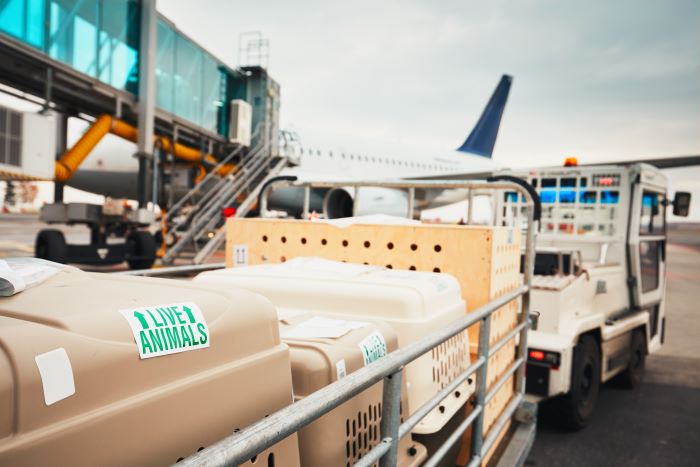
China allows one dog or one cat per household to be imported without quarantine, provided all documentation is complete and correct on arrival. This is manageable from the UK, but the process requires careful advance preparation – incomplete documentation triggers a quarantine period of 7 to 30 days.
Requirements for dogs and cats from the UK:
One pet per household can be imported without quarantine. A second pet will be subject to quarantine regardless of documentation.
Approved entry points: Beijing, Shanghai, Guangzhou, and Shenyang for pets arriving with declared paperwork. If your pet is flying into a different city, confirm approved entry ports with your destination agent.
Allow at least 8–12 weeks to complete the documentation process before your move date. A specialist pet relocator can coordinate the APHA endorsement, titer testing, and advance approval, working alongside your move manager on timing.
Real feedback from people who chose our international moving company.
“Moving to China involved a lot of planning, but the support we received made the entire process straightforward. The team explained each stage clearly, kept us updated throughout, and ensured everything arrived safely. We felt confident from the day we booked.”
“Our biggest concern was transporting our belongings halfway across the world, but everything arrived in excellent condition. The packing was first-class, the delivery team were fantastic, and the whole move to China was handled with real professionalism.”
“Relocating to China for work came with plenty of unknowns, but having an experienced moving company made all the difference. The communication was excellent, every deadline was met, and the team took the stress out of an international move. We’d happily recommend them to anyone moving overseas.”
Sea freight from the UK to Shanghai takes 40–45 days port-to-port; to Tianjin (serving Beijing) allow 44–49 days. Door-to-door including customs clearance and inland delivery: 9–11 weeks. Air freight takes 5–7 days for priority items.
No. The import permit for household goods cannot be applied for until the residence permit is in place. If your shipment arrives before this, it will be held at port. Plan dispatch timing around your permit timeline – not just your moving date.
One sea shipment and one air shipment per person per residence permit. Further shipments face heavy tax or may be refused. Plan your volumes before you leave.
The import permit is issued by China Customs and authorises your goods to enter duty-free. It can only be applied for after the residence permit is issued, takes approximately 3 working days to process, and is valid for 30 days. Your shipment must arrive and clear customs within that window.
Yes – one pet per household without quarantine, if all conditions are met: ISO microchip, rabies vaccination and titer test, full vaccination course, APHA-endorsed health certificate, and prior Chinese authority approval. Incomplete documentation means quarantine of 7–30 days on arrival.
Groupage for a 1-bedroom volume typically costs from £2,500–£4,000. A full 20ft container runs from £4,000–£6,500, and a 40ft container from £6,000–£9,500. A survey before booking gives you an accurate figure for your volume and destination city.
The residence permit timeline is the variable that controls everything in a China move – your move manager maps the shipment dispatch date to your expected permit date from the start, so your goods arrive when customs can actually release them. The process is predictable once the sequence is understood; the work is in the planning, not the shipping.